
📌 Key Takeaways
- Climbing stairs places 3 to 5 times your body weight on the patellofemoral joint.
- Weak hip stabilizers (gluteus medius) often cause the knee to buckle inward under load.
- Remember the golden stair rule: "Up with the good leg, down with the bad."
Climbing or descending a flight of stairs places significant load on the human knee joint—typically between 3 to 5 times your total body weight per step.
If you notice a sharp ache under your kneecap when walking upstairs, or a grinding, unstable feeling going downstairs, you are not alone. Stair-related knee discomfort is one of the most frequent complaints we assess at Nerivahealth in Faridabad.
Understanding what is causing this discomfort is the first step toward lasting relief.
1. Patellofemoral Pain Syndrome (Runner’s Knee)
The most common culprit behind pain at the front of the knee is Patellofemoral Pain Syndrome (PFPS).
Your kneecap (patella) sits inside a groove in your thigh bone (femur). When bending your knee under load, such as on stairs, uneven muscle pull can cause the kneecap to track improperly, irritating the sensitive cartilage underneath.
- Key Signs: Dull ache around the kneecap that worsens with stairs, prolonged sitting with bent knees, or squatting.
2. Early Knee Osteoarthritis
In adults aged 45 and above, cartilage wear between the femoral and tibial surfaces can make stair negotiation painful.
- Key Signs: Morning stiffness that improves after walking around for 15 minutes, occasional swelling, and a grinding or clicking sensation (crepitus).
3. Quadriceps and Hip Weakness
Many patients assume the problem lies entirely within the knee itself. In reality, the knee is a hinge joint trapped between the hip and the foot.
When your gluteus medius (hip stabilizer) and quadriceps are weak, your knee tends to collapse inward (valgus collapse) during each stair step, placing excessive torque on the joint capsule.
4. Patellar Tendinopathy (Jumper’s Knee)
Inflammation or micro-tears in the patellar tendon—connecting the kneecap to the shinbone—can cause sharp, localized pain directly below the kneecap during push-off.
What You Can Do Right Now
"Always lead with your stronger leg when going UP stairs, and lead with your painful leg when going DOWN stairs. This simple adjustment offloads up to 60% of peak shearing force on your affected knee."
1. Step Up With the Good Leg First
Remember the classic physiotherapy rule for stairs:
- Going Up: Lead with the unaffected (stronger) leg.
- Going Down: Lead with the affected (painful) leg.
- “Up with the good, down with the bad.”
2. Strengthen Your Glutes and Quadriceps
Gentle, low-impact exercises can strengthen the muscles supporting your knee without aggravating joint surfaces:
- Straight Leg Raises: Lie flat and lift your leg with knee locked straight. Repeat 12 to 15 times.
- Glute Bridges: Lie on your back with knees bent, squeeze your glutes, and lift your hips into a bridge.
- Terminal Knee Extensions: Use a resistance band to practice gentle end-range quad activation.
3. Avoid Prolonged Complete Rest
While you should avoid movements that trigger sharp pain, total rest causes surrounding muscles to weaken quickly, making the knee even less stable when you resume activity.
How Professional Physiotherapy Helps
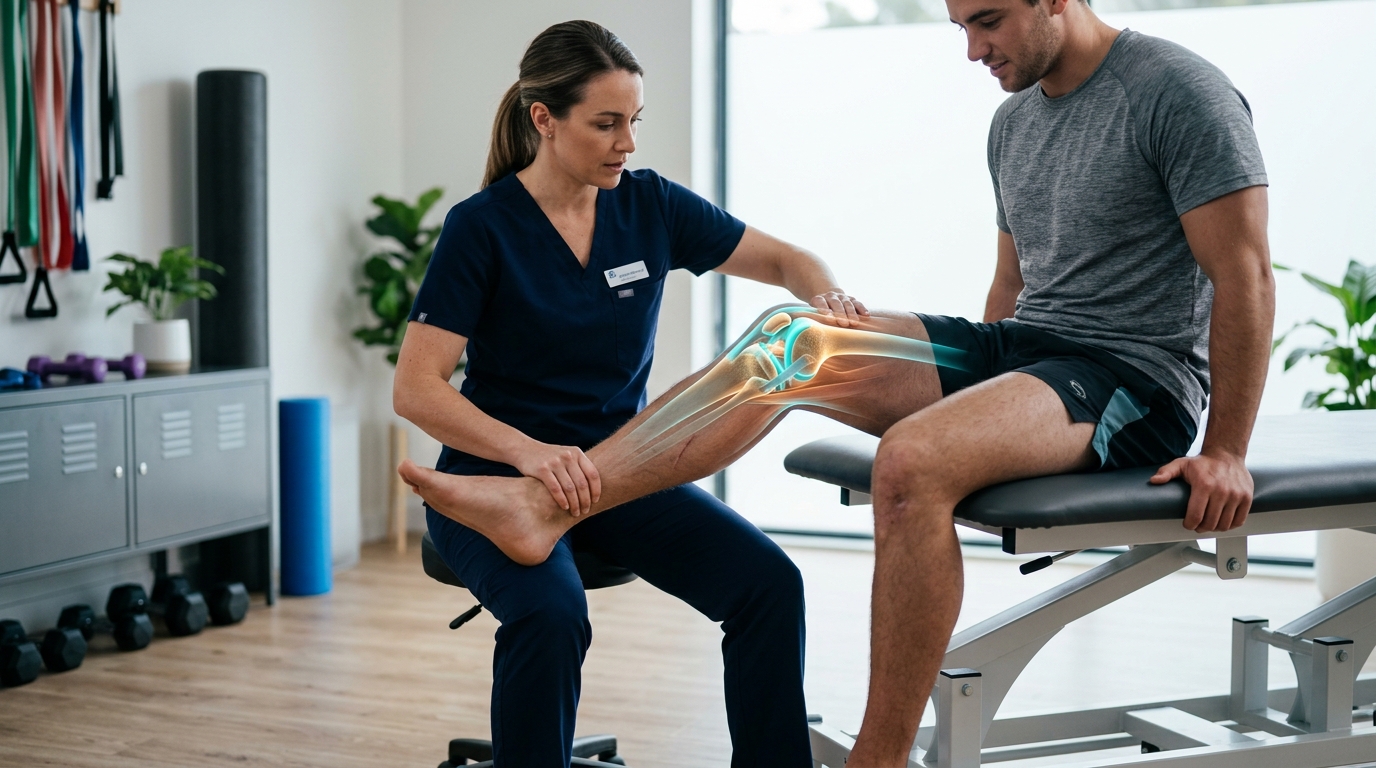
At Nerivahealth, Dr. Abhishek Kumar conducts comprehensive biomechanical evaluations:
- Identifying muscle imbalances across hips, quads, and ankles.
- Manual therapy and patellar mobilization to restore normal joint gliding.
- Taping techniques to offload kneecap pressure and allow pain-free walking.
- Progressive strength training tailored to your daily routine.
Suffering from similar symptoms?
Get an accurate diagnosis and a customized recovery plan from Dr. Abhishek Kumar.
Book Clinic Assessment Chat on WhatsApp